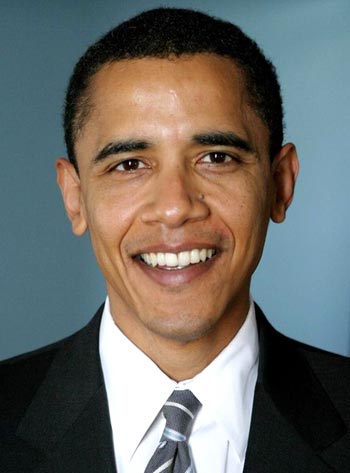
On Election Day (11/04/08), Barack Obama was elected President of the United States of America. Click
here for the national results, including those from New York State, and click
here for the results from Tompkins County. Groton, which was the only town in Tompkins County where John McCain received the most votes, voted for McCain by a narrow margin (3 votes-McCain 1,192/Obama 1,189).
My 8th graders (33 students) also voted last Tuesday in a mock election which followed 7 days of research and debate. I think you will find our results interesting, and the comments from our students profound.
Obama-13 votes
Nadar-10 votes
McCain-8 votes
McKinney-1 vote
Barr-1 vote
Baldwin-0 votes
Here are some comments from our future voters..."...but after reading what the candidates had to say, I changed my mind. I found it very surprising that some adults thought that McCain and Obama were the only two running." S.P.
"Many things meant a lot to me, but one thing was religion and how it effects almost all decisions the candidates make." H.G.
"I learned that the two major parties aren't always your best choice." E.H.
"I think that its great that we have an African-American President. I think that because of that people will have a different outlook on life..." S.C.
"One thing that meant the most to me researching these candidates was how they, and I felt about the war. It is a very important issue to me and I really wanted a candidate that agreed with me." K.H.
"It makes me mad that the main candidates, that are the only ones who got to be on the debates, aren't supporting gay rights." J.C.
"The most important thing I learned was to look at what everyone else had to say and to not just focus on my own opinion. I learned this in this lesson because we had to research different candidates." S.H.
"The one specific lesson I learned is that our country as a whole has come a long way from slavery and discriminating against blacks." B.L.
"...I changed my mind. ... _______ believed in more stuff that I do so I became a _________ supporter." KB
"I felt that finding out that there were more than two candidates meant the most to me." L.C.
"I think its a shame that third party candidates are always ignored in the media. I'm glad that I know about them now, because I believe that they deserve the same amount of coverage." A.C.
"...that Obama wants prayers in public schools. We don't need one. That's what churches are for." M.S.
"We need a system where everyone's vote means something, rather than there being an electoral college. It's that simple! It shouldn't take too much thought. There's all these people encouraging others to vote while a lot of their votes won't count anyway." J.T.
"...I never really knew that there were more than two people running for President. It was surprising to me to find out that only the Democrat and Republican were shown on TV..." A.C.
"One thing that means a lot is that the Republican Party and the Democratic Party really agree on a lot of subjects. I always heard that those two parties are so different, but really they are not." D.B.
"...it meant a lot to me to be able to learn what the issue was, what different people said about it, and how I thought about the issue afterwards." A.M
"Why can't they limit the amount of time that each candidate gets? To me it's not fair that Obama and McCain get more advertisements." A.J.
I think it is wonderful that Barack Obama won because now black kids are inspired. Yes they can. This is obviously history..." B.B.
"The most important perspective changing thing I learned is that many people are religious." N.C.
"How are the smaller parties supposed to get their ideas out when they get no publicity?" Anonymous
"Glassbooth changed my way of thinking a lot. Even though _______ is a good candidate I now think _______ is a better one." S.Y.
"Before I got on this site I would easily have voted for _________, but now after I looked over several issues and candidates positions, such as abortion, immigration, gun control, education, and science, I can easily say that I would vote for ______ (a different candidate)." J.O.
"I think some of the not so popular candidates had better opinions and outlooks on things rather than the popular." S.T.
"One thing from this lesson that meant the most to me was that a lot of people opposed gay marriage. The reason this is the thing from the lesson that meant the most to me is because I have a lot of gay people around me and they are no different than you and me." N.C.
"A lot of things have changed the way I think about the candidates. Especially the issue of abortion and birth control. The reason why I changed my thinking is because the people that don't agree with abortion are mostly males. ...They are not the ones that have to carry a baby for nine months. They are not the ones who have to go through the very painful birthing process." J.D.
"When I seen John McCain's losing speech it was really good. ...he talked about how Obama would be such a great President. He really got into my heart..." D.E.
"But I actually researched, and learned a lot about ________ before I picked who I wanted to be the President of the U.S." Z.D.
"The thing that meant the most is abortion. The reason it changed my thinking is because it's a woman's issue, but men are telling us that it's not ok..." C.S.
"I was surprised on how much I did not know. I didn't know how many issues there were. I didn't know about the issues or about what the candidates thought about them. Now I know about the issues that we studied. I know what each candidates thinks about the issues. ...and when I can vote, I will take them all into consideration and look up each candidate." B.S.
"The issue on gay marriage. I know people that are gay and I don't mind. I met them at my mom's B-Day party. ...when I found out he was gay, I didn't care he is still my friend." B. H. C.
"It was so hard to find which candidate to pick President of the United States of America." Z.D.
"I didn't even know there was a girl running still and there was Cynthia McKinney. She also had some good things to say. She probably would have been good at being a President. She also is African-American..." K.W.
"I don't know about you, but I like the way our future voters think." J.F.
Finally-I sent the following e-mail to the glassbooth site director:
To Whom This May Concern,
Our 8th grade Social Studies Classes used Glassbooth to research the candidates. We found the site helpful, and we were very glad you included the third party candidates. I was wondering if you plan to include follow up information now that the election is over (ie. How each candidate did? Demographic information/charts/graphs, or voter turn out etc.).
Thank you,
John
...I received this back from him promptly:
Thanks John,
We are currently discussing what we will do with the site. We may present some data on how people used the site. We may do a project which compares President Elect Obama's presidency to his campaign promises. We will do a blog that highlights cool sites like ours at the cross section of innovation and democracy.
Ian
Our students and I thought this was an awesome way to bring closure to this phase of the unit, and we thought that it spoke highly of the people at glassbooth to respond in such a fashion.
 I am extremely impressed with the level of learning that is taking place in all of our classes this year, but I would especially like to commend the 8th graders at this point in time for demonstrating incredible academic maturity, thoughtfulness, and critical thinking. You are encouraging me as a teacher, and I am enjoying your company each day. The unit we begin studying this next week may "blow you away!..." Hold on!!!